Olive Garden Flower Crochet Shoulder Bag
Advanced
For experienced crocheters who enjoy complex shaping, fine detail, and ambitious construction
Weekend Project
A satisfying weekend make — start Friday, finish Sunday, enjoy forever.
Handmade Gift
A beautiful keepsake — free forever. Read online or print at home.
About This Olive Garden Flower Crochet Shoulder Bag
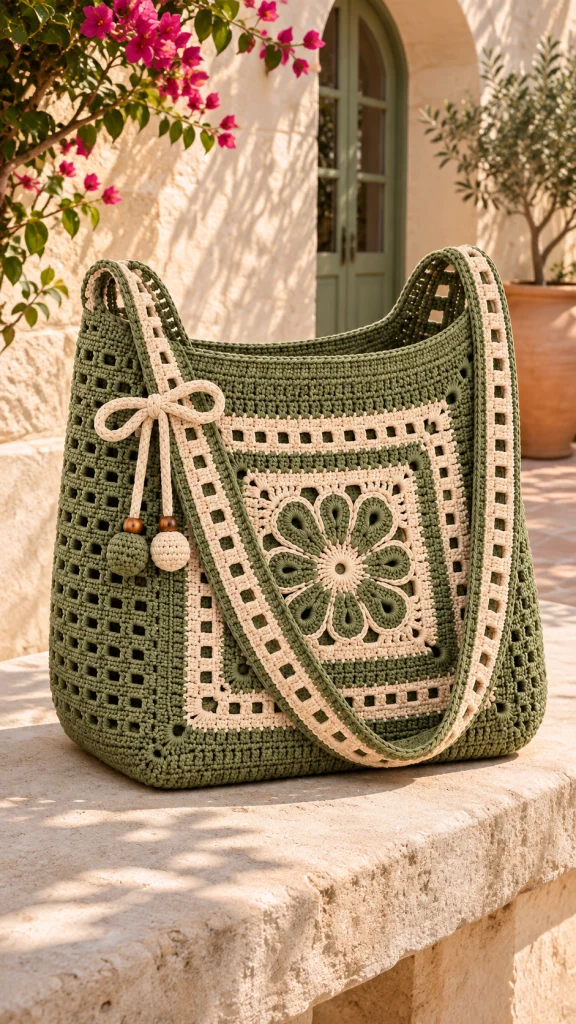
This flower crochet shoulder bag pattern brings together an olive green body, a cream-framed floral panel, and an openwork shoulder strap. The roomy gusset gives the bag its shape, while the raised eight-petal flower and small decorative tassels echo the garden-inspired design.
Allow approximately 18–24 hours for this advanced project. It suits crocheters who are comfortable working into chain spaces, keeping careful stitch counts, joining pieces of different row gauges, and sewing dimensional details securely.
The bag is worked in separate front and back panels with a long gusset joining the sides and base. A flower is sewn to the front panel, and an optional lining helps protect small belongings from the openwork.
Materials
- Worsted weight cotton yarn, approximately 650 yd in olive green, color A
- Worsted weight cotton yarn, approximately 250 yd in cream, color B
- 4 mm (US G/6) crochet hook, or size needed to obtain gauge
- Yarn needle
- Stitch markers
- Scissors
- Two wooden beads with holes large enough for the cream cord, optional
- A small amount of polyester fiberfill for the decorative balls
- Optional woven lining fabric, approximately 1/2 yd, plus matching thread and sewing needle
Abbreviations
Aolive green yarnBcream yarnchchainMRmagic ringreprepeatscsingle crochetsc2togsingle crochet the next 2 stitches togethersl stslip stitchststitchWSwrong sideFront and back panels
- Make 2 alike. With A, ch 49.
- Row 1: Sc in the second ch from the hook and in each remaining ch; turn. 48 sc.
- Rows 2–48: Ch 1, sc in each st; turn. 48 sc per row. Fasten off after row 48. Each panel measures approximately 12 in wide by 9.5 in high.
Flower background panel
- With B, ch 33.
- Row 1: Sc in the second ch from the hook and in each remaining ch; turn. 32 sc.
- Rows 2–4: Ch 1, sc in each st; turn. 32 sc per row. Change to A at the end of row 4.
- Rows 5–28: With A, ch 1, sc in each st; turn. 32 sc per row. Change to B at the end of row 28.
- Rows 29–32: With B, ch 1, sc in each st; turn. 32 sc per row. Fasten off, leaving a long sewing tail. The panel measures approximately 8 in wide by 6.5 in high.
- With B, sew a straight vertical line of running stitches approximately 3/4 in inside each side edge, connecting the cream top and bottom bands to suggest a frame.
Eight-petal flower
- With B, make an MR. Round 1: Ch 1, work 16 sc into the ring; join with a sl st to the first sc. Pull the ring closed. 16 sc.
- Round 2: Ch 1, sc in the same st, ch 7, skip 1 st; rep from the sc around, joining with a sl st to the first sc. 8 sc and 8 ch-7 loops. Fasten off B.
- Round 3: Join A with a sl st in any ch-7 loop. Work 8 sc into each loop around; join with a sl st to the first sc. 64 sc. Fasten off A.
- Round 4: Join B with a sl st in the first sc of any petal. Sc in each of the 8 sc across that petal, then sl st in the B sc at its base; rep for each remaining petal. 64 sc and 8 base sl sts. Fasten off, leaving a sewing tail.
- Arrange the petals evenly on the background panel. Sew the center and the base of each petal down, leaving the outer petal edges raised.
Openwork side and base gusset
- With A, ch 17.
- Row 1: Sc in the second ch from the hook and in each remaining ch; turn. 16 sc.
- Rows 2–5: Ch 1, sc in each st; turn. 16 sc per row.
- Row 6: Ch 1, sc in each of the first 2 sts, (ch 2, skip 2 sts, sc in each of the next 2 sts) 3 times, sc in each of the last 2 sts; turn. 10 sc and three ch-2 spaces.
- Row 7: Ch 1, sc in each sc and work 2 sc in each ch-2 space; turn. 16 sc.
- Rows 8–149: Rep rows 2–7 a total of 23 times, then rep rows 2–5 once. Each solid row has 16 sc; each openwork row has 10 sc and three ch-2 spaces.
- Rows 150–155: Rep rows 6, 7, 2, 3, 4, and 5 in that order.
- Row 156: Ch 1, sc in each st; turn. 16 sc. Fasten off. The strip is approximately 4 in wide and has 156 rows.
- Mark the boundaries between rows 48 and 49, and between rows 108 and 109. The first and last 48-row sections form the sides; the middle 60-row section forms the base.
Join the bag body
- With WS together and top edges aligned, pin one long gusset edge to the front panel: match the first 48 gusset rows to one 48-row side, the next 60 rows evenly across the 48-stitch bottom, and the final 48 rows to the other side. Place the row-boundary markers at the bottom corners.
- With A and a yarn needle, whipstitch the gusset to the panel through corresponding edge loops. Along the bottom, distribute the 60 gusset rows evenly across the 48 panel stitches without pulling the seam tight.
- Pin and whipstitch the other long gusset edge to the back panel in the same way. The two short gusset ends remain open at the top.
- With the right side facing, join A at a side seam. Work 48 sc across the front top, 16 sc across one gusset end, 48 sc across the back top, and 16 sc across the other gusset end; join with a sl st to the first sc. 128 sc.
- Work 2 more joined rounds of 128 sc, joining each round with a sl st to the first sc. Fasten off.
Ladder shoulder strap
- With B, ch 10.
- Row 1: Sc in the second ch from the hook and in each remaining ch; turn. 9 sc.
- Rows 2–3: Ch 1, sc in each st; turn. 9 sc per row.
- Row 4: Ch 1, sc in each of the first 3 sts, ch 3, skip 3 sts, sc in each of the last 3 sts; turn. 6 sc and one ch-3 space.
- Row 5: Ch 1, sc in each of the first 3 sc, work 3 sc in the ch-3 space, sc in each of the last 3 sc; turn. 9 sc.
- Rows 6–180: Rep rows 2–5 a total of 43 times, then rep rows 2–4 once. Row 180 is an openwork row.
- Row 181: Ch 1, sc in each of the first 3 sc, work 3 sc in the ch-3 space, sc in each of the last 3 sc. 9 sc. Fasten off. The strap is approximately 36 in long before attachment.
- With A, work 1 sc into the end of each row along one long strap edge; fasten off. Rep along the other long edge. 181 sc on each edge.
- Overlap each strap end approximately 1.5 in inside the bag at the center of a gusset end. Sew a secure rectangle around each overlap, then sew diagonally across it in both directions. Keep the strap untwisted.
Decorative cord and balls
- With B, make a chain approximately 24 in long and fasten off. Thread one wooden bead onto each end if using beads.
- Make 2 balls, one in A and one in B. Work in continuous rounds and mark the first st of each round.
- Round 1: Work 6 sc in an MR. 6 sc.
- Round 2: Work 2 sc in each st around. 12 sc.
- Round 3: (Sc in the next st, 2 sc in the next st) 6 times. 18 sc.
- Rounds 4–6: Sc in each st around. 18 sc per round.
- Round 7: (Sc in the next st, sc2tog) 6 times. 12 sc. Add a small amount of fiberfill.
- Round 8: Sc2tog 6 times. 6 sc. Fasten off, leaving a tail; thread the tail through the front loops of the remaining sts and pull closed.
- Sew one ball firmly to each cord end below its bead. Tie the cord into a bow around one strap attachment and secure the knot with a few stitches.
Finishing
Center the flower panel on the front of the bag, leaving an even olive margin at the sides. Sew around all four edges with the reserved B tail. Weave in every end securely, then gently shape the bag and allow it to dry flat if blocking is needed.
For a lining, measure the completed bag and sew a fabric insert with a front, back, and gusset to match, adding seam allowances. Fold the lining’s upper edge under and hand-sew it just below the crocheted rim, keeping stitches invisible from the outside.
Tips for Success
- Check both stitch and row gauge before starting; the gusset relies on the difference between them.
- Pin the gusset at both corners and at the midpoint of each section before sewing so the base stays flat.
- Keep the petal edges loose when attaching the flower to preserve their raised shape.
- Reinforce the strap overlaps with strong sewing stitches, especially if the bag will carry heavier items.
Common Mistakes to Avoid
- If the gusset puckers at the base, remove that section of seam and redistribute its 60 rows across the 48 bottom stitches.
- If an openwork row gains stitches, count 10 sc and three ch-2 spaces before turning.
- If the strap twists, lay it flat and check its direction before sewing the second end.
- If the flower curls tightly, loosen the edging stitches and sew only the center and petal bases down.
Ways to Customize This Pattern
- Replace cream with a warm rust or pale gold while keeping olive as the main color.
- Lengthen the strap by repeating rows 2–5 as many times as needed, ending with row 5 before adding the edging.
- Make the back panel decorative too by adding a second background panel and flower.
- Add an internal fabric pocket to the lining before sewing the lining into the bag.
Frequently asked questions
Yes. Choose a firm, low-stretch yarn of similar weight and make a gauge swatch. A softer or stretchier yarn may make the bag and strap longer under load.
A lining is optional, but it is useful for keeping small items from slipping through the openwork and for giving the bag more structure.
Stop the four-row strap repeat when it is close to your preferred length, ending after a row 5 repeat. Allow for the 1.5 in overlap at each end when estimating the visible strap length.
Follow the yarn and lining care instructions. Gentle hand washing and reshaping flat are a practical choice for many cotton yarns; remove or protect the wooden beads if their finish is not washable.
The finished Olive Garden Flower Crochet Shoulder Bag