Autumn Sunflower Crochet Table Runner Pattern
Beginner Friendly
Perfect for those just starting their crochet journey, with clear instructions and simple techniques
Single-Day Project
A satisfying project you can complete in a single afternoon or evening.
Handmade Gift
A beautiful keepsake — free forever. Read online or print at home.
About This Autumn Sunflower Crochet Table Runner Pattern
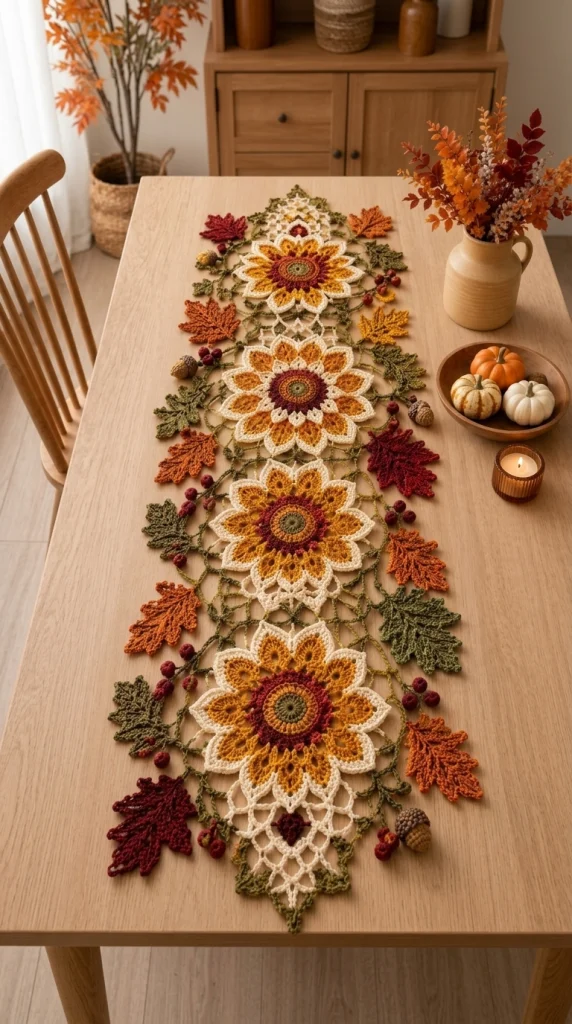
This autumn sunflower crochet table runner pattern combines delicate openwork crochet with large layered flowers, colorful fall leaves, tiny berries and crocheted acorns. The result is an elegant handmade centerpiece designed to bring warm autumn color to a dining table, console or coffee table.
The centerpiece features four large floral medallions arranged vertically along an olive-green openwork foundation. Each flower combines a textured circular center with mustard-gold petals and a second layer of cream pointed petals. Maple-inspired leaves in burnt orange, burgundy, mustard and olive green decorate both sides of the runner.
Small berry clusters, vines and acorns fill the spaces between the larger motifs. The pointed lace ends give the runner a delicate finish while keeping the overall design light and decorative rather than heavy.
Materials
- DK cotton yarn in warm cream approximately 180 g
- DK cotton yarn in mustard gold approximately 120 g
- DK cotton yarn in olive green approximately 100 g
- DK cotton yarn in burgundy approximately 60 g
- DK cotton yarn in burnt orange approximately 70 g
- DK cotton yarn in dark brown approximately 30 g
- DK cotton yarn in medium brown approximately 20 g
- 3.5 mm crochet hook main runner
- 3.0 mm crochet hook berries and acorns
- Yarn needle assembly
- Stitch markers optional
- Blocking mats and rust-resistant pins recommended
- Scissors 1 pair
Abbreviations
MRmagic ringchchainsl stslip stitchscsingle crochethdchalf double crochetdcdouble crochettrtreble crochetdtrdouble treble crochetinc2 stitches in the same stitchpicotch 3, sl st into first chFOfasten offLarge Sunflower Medallions – Make 4
Flower Center
- With olive green yarn, make an MR.
- Round 1: Work 12 dc into MR. Join with sl st. (12)
- Round 2: Ch 2, work 2 dc in each st around. Join. (24)
- Change to mustard yarn.
- Round 3: Ch 1, *sc in next st, 2 sc in next st*. Repeat around. Join. (36)
- Change to burgundy yarn.
- Round 4: Ch 2, *dc in next 2 sts, 2 dc in next st*. Repeat around. Join. (48)
- Round 5: Ch 1, sc in each st around. Join. (48)
Golden Inner Petals
- Change to mustard-gold yarn.
- *Sl st in next st, ch 8.
- Sc in second ch from hook, hdc in next ch, dc in next 2 ch, tr in next 2 ch, dc in final ch.
- Skip 2 stitches on flower center and sl st in next stitch.*
- Repeat around to create approximately 16 pointed petals.
- FO.
Cream Outer Petals
- Turn the flower over and join cream yarn behind the golden petal layer.
- Work surface sl sts around the base of the petals to create an attachment round.
- *Ch 10, sc in second ch from hook, hdc, dc, tr, dtr, tr, dc, hdc, sc.
- Sl st into the next attachment space.*
- Repeat around, positioning each cream petal between two golden petals.
- FO and weave in ends.
- Block each petal into a sharp, symmetrical point.
Olive Openwork Vine Foundation
- With olive green yarn, ch 181.
- Row 1: Sc in second ch from hook and across. (180)
- Row 2: Ch 6, turn, skip 3 sts, sc in next st, *ch 5, skip 3 sts, sc in next st*. Repeat across.
- Row 3: Ch 6, turn, sc into first ch-5 space, *ch 5, sc into next ch-5 space*. Repeat across.
- Rows 4-7: Repeat Row 3.
- FO.
This narrow mesh strip forms the central backbone of the runner. The four large flowers will cover much of it during assembly, while the visible sections create the delicate vine-like appearance between motifs.
Cream Diamond Lace Sections – Make 5
- With cream yarn, ch 9.
- Row 1: Sc in first ch to create a loop.
- Row 2: Ch 5, sc into previous loop, ch 5, sc into same loop.
- Row 3: Ch 5, sc in first ch-5 loop, ch 5, sc between loops, ch 5, sc in second loop.
- Continue increasing in this manner until the lace section measures approximately 14 cm wide.
- Work 2 rows without increasing.
- Begin decreasing by omitting the first and final chain loop of each row.
- Continue until one loop remains.
- FO and block into a diamond shape.
Pointed Cream End Lace – Make 2
- With cream yarn, ch 5 and join with sl st.
- Row 1: Ch 5, sc into ring, ch 5, sc into ring.
- Row 2: Ch 5, sc into first loop, ch 5, sc between loops, ch 5, sc into final loop.
- Continue increasing one mesh space on each side until the piece measures approximately 30 cm wide.
- Work 2 rows evenly.
- Decrease one mesh space at each side until a pointed end remains.
- Work a final cream picot around the outer point.
- FO and block firmly.
Maple Leaves – Make 14-18
Use a mixture of olive green, burnt orange, mustard and burgundy.
- Ch 13.
- Sl st in second ch from hook.
- Sc in next ch, hdc in next, dc in next 2, tr in next 2, dc in next 2, hdc, sc, sl st in final ch.
- Working down the opposite side of the foundation chain, repeat the stitch sequence in reverse.
- At the bottom, ch 5 and sl st back along the chain to form a short stem.
Leaf Lobes
- Join yarn approximately one third of the way up the leaf edge.
- Ch 7.
- Sc in second ch, hdc, dc, tr, dc, hdc.
- Sl st back into the leaf edge.
- Repeat to make 2 side lobes on each side.
- For a fuller maple shape, add one smaller lobe near the lower edge on each side.
- FO.
- Use surface slip stitches from the stem toward each lobe to imitate leaf veins.
Small Olive Leaves – Make 12
- With olive yarn, ch 9.
- Sc in second ch from hook.
- Hdc in next ch, dc in next 3 ch, hdc in next, sc in next.
- Work 3 sc in final ch.
- Continue along opposite side: sc, hdc, dc in next 3, hdc, sc.
- Join with sl st.
- Ch 5 and sl st back along chain for stem.
- FO.
Berries – Make 24-30
Use mostly burgundy yarn with a few mustard berries if desired.
- With 3.0 mm hook, make an MR.
- Round 1: 6 sc in MR. (6)
- Round 2: Inc around. (12)
- Round 3: Sc around. (12)
- Round 4: Dec around. (6)
- Add a tiny amount of stuffing or a small yarn scrap.
- FO and pull the opening closed.
- Leave a long tail for attaching the berry to the vine.
Berry Vines – Make 8-10
- With olive yarn, ch 18-28, varying the length between vines.
- Sl st back through every chain.
- Attach 2-4 crocheted berries along each vine.
- Add one or two tiny leaves if desired.
- Leave both ends long for sewing to the mesh foundation.
Crochet Acorns – Make 6
Acorn Body
- With medium brown yarn and 3.0 mm hook, make an MR.
- Round 1: 6 sc in MR. (6)
- Round 2: Inc around. (12)
- Round 3: *Sc, inc*. Repeat around. (18)
- Rounds 4-6: Sc around. (18)
- Round 7: *Sc, dec*. Repeat around. (12)
- Stuff lightly.
- Round 8: Dec around. (6)
- FO and close.
Acorn Cap
- With dark brown yarn, make an MR.
- Round 1: 6 sc in MR. (6)
- Round 2: Inc around. (12)
- Round 3: *Sc, inc*. Repeat around. (18)
- Round 4: BLO sc around. (18)
- FO leaving a long tail.
- Sew the cap over the top third of the acorn body.
- Attach a short ch-5 stem to the center of the cap.
Connecting the Flower Motifs
- Lay the olive mesh foundation flat on a blocking mat.
- Place the four large flowers evenly along the center line.
- Leave approximately 8-10 cm of visible openwork between flowers.
- Place one cream diamond lace section between each pair of flowers.
- Place one additional cream lace section above the first flower and one below the final flower.
- Pin everything before sewing.
- Using matching yarn, sew each flower through its center and the base of several outer petals.
- Leave the pointed outer edges of some petals slightly free to preserve dimension.
Side Vine Extensions
- Join olive yarn to an exposed mesh loop beside a flower.
- Ch 12-20 depending on the space available.
- Sl st back along the chain to create a narrow vine.
- Join the vine to another mesh loop.
- Repeat around both sides of the runner to create irregular branching lines.
- Avoid making the arrangement perfectly symmetrical; a slightly organic distribution creates a more natural botanical effect.
Decorative Side Leaves
- Arrange the larger maple leaves around the outside of the olive mesh.
- Alternate colors rather than grouping identical shades together.
- Place olive leaves near mustard and burgundy flowers to visually connect the runner.
- Sew each leaf mainly through its center vein.
- Add one small stitch near each outer lobe while allowing the tips to remain slightly raised.
Berry and Acorn Placement
- Arrange berry clusters in small groups of 2-4 along the side vines.
- Place acorns near the outer edges rather than directly beside the flower centers.
- Distribute the acorns between both sides of the runner.
- Sew each berry firmly through its base.
- Secure acorns through both the cap and lower body so they remain stable.
Decorative Olive Border
- Join olive yarn to one pointed end.
- Work sc evenly around all exposed cream lace edges.
- At each major point, work *sc, ch 3, sc* in the same space.
- Along mesh sections, work 3 sc into each large chain space.
- Continue around the entire runner.
- Join with sl st and FO.
Final Assembly
Place the entire runner on a large flat surface. Begin with the four flower medallions and central lace pieces, making sure the runner remains straight from one end to the other. Sew these major pieces first.
Next, attach the cream pointed end sections. Add the olive side vines, followed by the large autumn leaves. Keep the leaves angled outward so the silhouette of the runner looks botanical rather than rectangular.
Add the small olive leaves, berry vines and acorns last. These smaller elements should fill empty spaces without hiding the open lacework. Keep some sections of olive mesh visible between the decorations.
Once all pieces are attached, weave in every yarn end securely on the back. Steam or wet-block the complete runner, carefully shaping each sunflower petal, maple leaf and pointed lace section.
Blocking
- Soak the finished runner briefly in cool water if your yarn allows wet blocking.
- Gently squeeze out excess water without twisting.
- Place the runner lengthwise on blocking mats.
- Pin both pointed ends first.
- Measure approximately 140 cm from point to point.
- Pin the widest areas to approximately 34 cm.
- Shape every cream flower petal individually.
- Stretch the olive mesh gently until the diamond openings are even.
- Pin the tips of the maple leaves to define their shape.
- Allow the runner to dry completely before removing the pins.
Tips for Success
- Block as you go: The flowers and leaves are easier to assemble when they have already been shaped.
- Keep the mesh loose: Tight chains will make the runner bunch around the flowers.
- Use cotton yarn: Cotton gives the lace and leaf points better definition.
- Leave some negative space: Do not completely cover the olive mesh with leaves and berries.
- Pin before sewing: Arrange the entire composition first so the four large flowers stay aligned.
- Vary the leaf colors: Mixing burgundy, rust, mustard and olive creates the rich autumn appearance.
Common Mistakes to Avoid
- Skipping blocking: The openwork will look uneven and the flowers may curl.
- Sewing every petal completely flat: Attach the petals mainly near their bases to preserve some dimension.
- Using very bulky yarn: The delicate mesh can lose its definition.
- Making all leaves the same color: The design depends on varied fall shades for depth.
- Overcrowding the edges: Leave visible sections of vine between the leaves, berries and acorns.
- Uneven flower spacing: Measure before attaching the four main medallions.
Ways to Customize This Pattern
- Use sage, cream and muted terracotta for a softer farmhouse version.
- Replace burgundy with deep plum for a more elegant autumn palette.
- Make only three flowers for a shorter coffee-table runner.
- Add additional acorns and leaves for a fuller Thanksgiving centerpiece.
- Use only cream and beige for a neutral year-round botanical runner.
- Replace the sunflower colors with red, cream and green to adapt the construction for Christmas.
Frequently Asked Questions
Using DK cotton yarn and a 3.5 mm hook, the finished runner is approximately 140 cm long and 34 cm wide after blocking. Your exact measurements may vary depending on yarn, hook size and tension.
Yes. The modular construction makes resizing straightforward. Use three large flower motifs instead of four and remove one connecting lace section. For a longer dining table, add another flower and connecting section.
The individual stitches are manageable, but the project involves layered motifs, lace mesh, shaping, blocking and substantial assembly. It is therefore better suited to confident intermediate crocheters or advanced beginners who are comfortable following multi-part patterns.
A smooth cotton or cotton-blend yarn is ideal because it clearly defines the flower petals, lace openings and pointed leaves. Avoid very fuzzy yarn if you want the botanical details to remain crisp.
Keep the chain stitches in the openwork foundation relaxed, avoid pulling tightly while joining motifs and block the complete runner after assembly. Pinning the flowers, lace points and leaves individually during blocking makes a major difference.
Yes. The sunflower-inspired flowers, maple leaves, berries, acorns and warm rust, mustard, burgundy and olive palette make the runner especially suitable for fall and Thanksgiving decorating.
Follow the care instructions for your chosen yarn. For cotton, gentle hand washing in cool water is usually the safest option for a heavily decorated piece. Lay it flat to dry and reshape the flowers, leaves and lace while damp.
The finished Autumn Sunflower Crochet Table Runner Pattern