Christmas Plaid Crochet Blanket Pattern
Beginner Friendly
Perfect for those just starting their crochet journey, with clear instructions and simple techniques
Single-Day Project
A satisfying project you can complete in a single afternoon or evening.
Handmade Gift
A beautiful keepsake — free forever. Read online or print at home.
About This Christmas Plaid Crochet Blanket Pattern
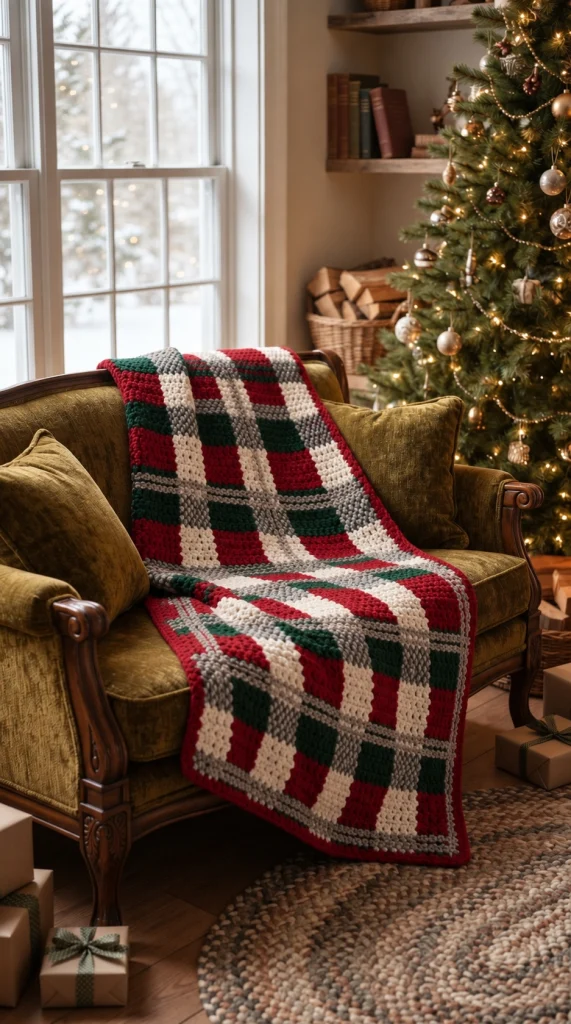
This Christmas plaid crochet blanket pattern creates a wonderfully cozy holiday throw inspired by classic winter tartan. Deep Christmas red, forest green, warm cream and soft gray are arranged into chunky blocks and narrow crossing stripes for a traditional plaid effect.
The blanket is designed to feel substantial and warm without being overly complicated. The main fabric is built from simple crochet stitches, while carefully planned color changes create the festive check pattern. Finished with a neat red border, it makes a beautiful throw for an armchair, sofa, guest room or Christmas gift.
Materials
- Bulky / chunky #5 yarn – Christmas red 700-850 g
- Bulky / chunky #5 yarn – forest green 550-700 g
- Bulky / chunky #5 yarn – warm cream 650-800 g
- Bulky / chunky #5 yarn – soft gray 400-500 g
- 6-6.5 mm crochet hook 1
- Yarn needle 1
- Stitch markers 4-6
- Scissors 1 pair
- Measuring tape 1
Abbreviations
chchainsl stslip stitchscsingle crochethdchalf double crochetdcdouble crochetststitchstsstitchesreprepeatRSright sideWSwrong sideFOfasten offFinished Size
- Width: approximately 120-130 cm
- Length: approximately 150-160 cm
- Border: approximately 3-4 cm
The size is easy to adjust by adding or removing complete plaid repeats.
Gauge
Approximately 12 hdc × 10 rows = 10 cm using a 6-6.5 mm hook.
Gauge does not need to be exact for a blanket, but consistent tension is important because uneven stitches can distort the straight plaid lines.
Christmas Plaid Color Palette
- Color A – Red: rich cranberry or classic Christmas red
- Color B – Green: deep forest or evergreen
- Color C – Cream: warm ivory rather than bright white
- Color D – Gray: medium soft gray
The warm cream softens the strong red and green while gray gives the plaid a more traditional woven appearance.
Understanding the Plaid Layout
The blanket combines wide color blocks with narrow contrasting stripes. The horizontal stripes are crocheted directly into the rows. The vertical lines can either be created with controlled color changes or added afterward using surface crochet.
For the cleanest version, this pattern uses horizontal color sections first and adds selected vertical lines afterward.
Foundation
Using cream:
- Ch 151 loosely.
- Hdc in the 2nd ch from the hook.
- Hdc across. (150 sts)
- Ch 1 and turn.
If your foundation chain tends to tighten, use a hook 0.5-1 mm larger for the chain only.
Main Stitch Pattern
The blanket body is worked primarily in half double crochet.
- Ch 1 at the beginning of each row. This does not count as a stitch.
- Hdc in every stitch across.
- Turn after every row.
- Maintain 150 stitches throughout the blanket.
Basic Plaid Row Sequence
Use this sequence as one large repeating tartan section:
- Rows 1-8: Cream
- Rows 9-10: Gray
- Rows 11-18: Red
- Rows 19-20: Gray
- Rows 21-28: Forest Green
- Rows 29-30: Cream
- Rows 31-38: Red
- Rows 39-40: Gray
- Rows 41-48: Cream
Repeat this sequence until the blanket reaches approximately 150 cm or your preferred length.
Creating the Large Check Sections
To bring the blanket closer to a true tartan appearance, divide the width into repeated sections.
A useful 30-stitch repeat is:
- 10 sts Red
- 4 sts Cream
- 10 sts Green
- 3 sts Gray
- 3 sts Cream
Repeat the sequence five times across the 150-stitch width.
On rows where the horizontal color already matches one of these sections, allow that color to visually merge into the block. This creates the characteristic overlapping plaid effect.
Changing Colors Within a Row
- Work the final hdc of the current color until three loops remain on the hook.
- Drop the old color.
- Yarn over with the new color.
- Pull the new color through all three loops.
- Continue crocheting with the new color.
Use separate small yarn balls for the larger sections instead of carrying several strands across the entire blanket.
Simpler Plaid Method
If you prefer fewer color changes, crochet the entire blanket in horizontal stripes first. The vertical plaid lines can then be added using surface slip stitches.
This method is particularly useful for beginners and produces a clean decorative result.
Surface Crochet Vertical Lines
Lay the finished blanket flat with the right side facing upward.
- Attach yarn at the bottom edge.
- Insert the hook through the fabric along a straight vertical column.
- Pull up a loop.
- Work surface slip stitches vertically toward the top.
- Keep the stitches loose enough that the blanket remains flat.
- FO at the top.
Add vertical lines in red, cream, green and gray according to your desired plaid arrangement.
Suggested Vertical Stripe Placement
Across a 150-stitch blanket, place narrow vertical lines approximately at:
- Stitch 15 – Gray
- Stitch 30 – Cream
- Stitch 45 – Green
- Stitch 60 – Gray
- Stitch 75 – Red
- Stitch 90 – Cream
- Stitch 105 – Green
- Stitch 120 – Gray
- Stitch 135 – Red
For thicker vertical stripes, work two or three adjacent columns in the same color.
Optional Textured Sections
For a chunkier handmade appearance, selected blocks can be worked using front-loop or back-loop hdc.
- Choose one wide stripe in each repeat.
- Work hdc in the back loops only.
- Return to regular hdc for the next stripe.
This creates subtle raised ridges without disturbing the plaid design.
Blanket Border
Use Christmas red for a strong framed finish.
Round 1
- Attach red yarn in any corner.
- Ch 1.
- Sc evenly around the entire blanket.
- Work 3 sc into every corner.
- Join with sl st.
Round 2
- Ch 1.
- Hdc in every stitch.
- Work 3 hdc into each corner stitch.
- Join with sl st.
Round 3
- Ch 1.
- Sc around.
- Work 3 sc into each corner.
- Join and FO.
Optional Gray Inner Border
For an even stronger tartan look, work one narrow round of gray before adding the red outer border.
- Attach gray yarn.
- Sc evenly around the blanket.
- Work 3 sc into each corner.
- FO.
- Attach red and continue with the main border.
Blocking
- Weave in all yarn ends.
- Lay the blanket flat on blocking mats or a clean surface.
- Gently shape it into a rectangle.
- Measure opposite sides to ensure they match.
- Lightly mist or steam according to the yarn fiber instructions.
- Allow the blanket to dry completely before moving it.
Optional Fringe
If you prefer a more traditional tartan blanket, add fringe instead of a full border.
- Cut yarn strands approximately 22-25 cm long.
- Group 3-4 strands together.
- Fold them in half.
- Pull the folded loop through the blanket edge.
- Pass the loose ends through the loop.
- Tighten gently.
- Repeat evenly along both short edges.
Mix red, cream, green and gray fringe for a playful Christmas finish.
Size Adjustments
- Baby blanket: approximately 75 × 95 cm
- Lap blanket: approximately 95 × 120 cm
- Standard throw: approximately 125 × 155 cm
- Large sofa blanket: approximately 145 × 180 cm
- Bed throw: approximately 170 × 210 cm
For the most balanced appearance, add or remove complete plaid repeats rather than individual stitches.
Alternative Christmas Color Palettes
- Traditional: cranberry red + forest green + cream + gray
- Vintage Christmas: burgundy + olive + oatmeal + taupe
- Snowy Cabin: deep green + ivory + charcoal + muted red
- Elegant Christmas: wine red + cream + dark chocolate + gold-beige
- Scandinavian: red + ivory + light gray
- Neutral Christmas: cream + camel + mocha + muted green
Ways to Customize Your Blanket
- Add tassels to the four corners.
- Add a leather or faux-leather handmade label.
- Use velvet yarn for selected stripes.
- Add a narrow gold or metallic accent line.
- Replace gray with warm camel.
- Use burgundy instead of bright Christmas red.
- Add fringe instead of the red border.
- Make matching plaid cushion covers with leftover yarn.
Care Instructions
Follow the care instructions printed on your yarn label. For most acrylic or acrylic-blend chunky yarns, gentle machine washing or hand washing in cool water works well.
Lay the blanket flat or tumble dry on low only if your yarn specifically allows it. Avoid high heat, which can flatten the crochet texture.
Frequently Asked Questions
The stitches are beginner friendly, but frequent color changes require patience. The simplified version using horizontal stripes and surface crochet vertical lines is the easiest option for newer crocheters.
Yes. Use a smaller hook appropriate for your yarn and increase the number of stitches and rows to reach the desired blanket size.
Use separate small yarn balls for each active color section and arrange them in the same order as the blocks across your row. Turn the blanket in alternating directions whenever possible instead of continuously twisting all the yarns together.
Yes. Red, forest green and cream make a beautiful classic Christmas plaid. The gray simply adds another layer of depth to the tartan effect.
Choose a soft premium acrylic, acrylic-wool blend or washable wool blend. Make a swatch first because very fluffy yarn can reduce the definition of the plaid lines.
Yes. Use the same plaid repeat to crochet two smaller rectangular or square panels, then seam them around a cushion insert.
For a standard throw, plan for approximately 2.3-2.8 kg of chunky yarn in total. Buying an extra skein of each main color is helpful for matching dye lots and making gauge or size adjustments.
The finished Christmas Plaid Crochet Blanket Pattern