Lavender Heirloom Crochet Bedspread Pattern
Advanced
For experienced crocheters who enjoy complex shaping, fine detail, and ambitious construction
Single-Day Project
A satisfying project you can complete in a single afternoon or evening.
Handmade Gift
A beautiful keepsake — free forever. Read online or print at home.
About This Lavender Heirloom Crochet Bedspread Pattern
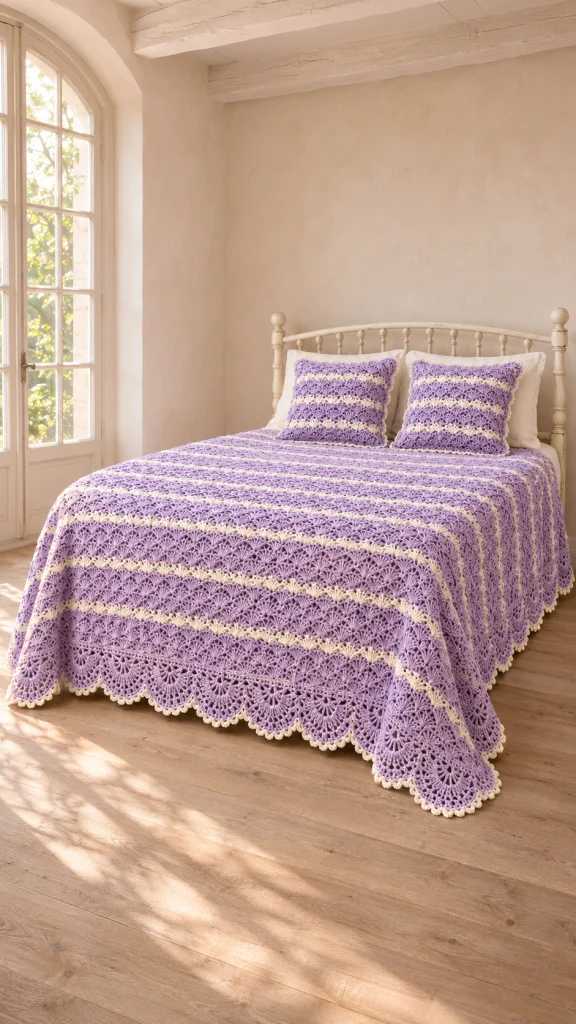
The Lavender Heirloom crochet bedspread pattern pairs lavender shell lace with narrow ivory stripes and a deep, scalloped edge. The repeating fans create an airy fabric with enough visual detail to dress a bed beautifully while letting a plain cover underneath show through.
This advanced project uses a continuous rectangular panel, alternating full and half shells, carefully distributed edge stitches, and an expanded fan border finished with ivory picots. Allow approximately 100–140 hours, plus blocking and drying. It suits experienced crocheters who enjoy maintaining long repeats and shaping a large lace border.
The finished bedspread measures approximately 88 × 94 inches after blocking. On a 60 × 80-inch mattress, that gives about 14 inches of drop at each side; the length available at the foot depends on placement at the head. This pattern covers the bedspread only; coordinating cushions shown in the styling are not included.
Materials
- Sport-weight/category 2 cotton or cotton-blend yarn, approximately 8,000 yards (7,315 m) in lavender, including swatching allowance.
- Matching yarn, approximately 1,400 yards (1,280 m) in ivory, including swatching allowance.
- 4 mm crochet hook, or size needed to obtain blocked gauge.
- Optional 4.5 mm hook for a relaxed foundation chain.
- Locking stitch markers, including four contrasting corner markers.
- Tapestry needle and scissors.
- Measuring tape, rustproof blocking pins, and sufficient blocking mats or a clean padded surface.
Abbreviations
chchainscsingle crochetdcdouble crochettrtreble crochetsl stslip stitchststitchspspaceRSright sideUS crochet terminology is used throughout. A shell is 7 dc in one stitch. The center of a shell is its fourth dc. A picot is ch 3, then sl st through the front loop and left vertical bar of the sc just made.
Gauge Swatch and Size Planning
- With lavender, ch 34. Sc in the second ch from the hook and each remaining ch: 33 sc. This foundation supports four horizontal repeats.
- Work Body Rows 1–16 below, substituting four repeats for 28: use four shells in Row B and three full shells between the two half shells in Row A.
- Block the swatch gently. Measure between equivalent shell centers across three repeats, then divide by three; the target is 3 inches per repeat. Measure 16 pattern rows away from the foundation edge; the target height is 9 inches.
- The main body contains 28 horizontal repeats and 160 pattern rows, giving approximately 84 × 90 inches before its approximately 2-inch border on each edge.
- For another width, choose a whole number N of repeats. Chain 8N + 2 and make 8N + 1 foundation sc. The blocked body width is approximately 3N inches; add approximately 4 inches for the border.
- For another length, finish on an even-numbered pattern row. To retain the stated border repeat without redistribution, use a pattern-row total divisible by 8 and pick up one fewer side stitch between corner stitches than that row total.
Bedspread Body
- Foundation: with lavender, ch 226 loosely. Sc in the second ch from the hook and in every remaining ch: 225 sc. Turn. This foundation row is separate from the 160 numbered pattern rows.
- Row 1, Row B: ch 1, sc in the first sc; repeat the following 28 times: skip 3 sc, work 7 dc in the next sc, skip 3 sc, sc in the next sc. Turn. Count: 28 shells and 29 sc, totaling 225 stitches. The turning ch does not count.
- Row 2, Row A: ch 3, counting as the first dc, and work 3 dc in the first sc. Skip the first 3 dc of the next shell and sc in its fourth dc. Repeat the following 27 times: skip the remaining 3 dc of that shell, work 7 dc in the next sc, skip the first 3 dc of the next shell, sc in its fourth dc. Skip the last 3 dc and work 4 dc in the final sc. Turn. Count: two 4-dc half shells, 27 full shells, and 28 sc, totaling 225 stitches.
- Row 3, Row B: ch 1, sc in the first dc. Repeat the following 28 times: skip 3 dc, work 7 dc in the next sc, skip 3 dc, sc in the next dc. For the first 27 repeats, that final sc falls in the fourth dc of a full shell; for the last repeat, it falls in the top of the turning ch-3. Turn. Count: 28 shells and 29 sc, totaling 225 stitches.
- Row 4: repeat Row 2. Count: 225 stitches.
- Rows 5–160: work Row B on every odd-numbered row and Row A on every even-numbered row. Each row contains 225 stitches. Follow the exact color schedule in the next section.
- After Row 160, fasten off. Mark the face you prefer as the RS. Do not sew separate strips together; the stripes are worked directly into this continuous panel.
Lavender and Ivory Stripe Sequence
- Rows 1–16: work in lavender.
- Rows 17–18: work in ivory.
- Repeat this complete 18-row color block seven more times, covering Rows 19–144. Within every block, work 16 lavender rows followed by 2 ivory rows.
- Rows 145–160: work in lavender. The completed body has nine lavender bands of 16 rows and eight ivory bands of 2 rows: 144 lavender rows plus 16 ivory rows equals 160 rows.
- At each color change, draw the new color through the final two loops of the last dc in Row A. Cut the previous color, leaving an 8-inch tail. Keep the established Row A/Row B sequence unchanged across the color changes.
Border Foundation and Corner Placement
- Lightly block the body to approximately 84 × 90 inches and let it dry. With the RS facing, identify and mark its four corner stitches. The top and bottom each have 225 available stitch positions, including their corners.
- Round 1: join lavender at the top-left corner and ch 1. Work 1 sc in that corner and mark it. Work 1 sc in each of the next 223 stitches across the top, then 1 sc in the top-right corner and mark it. There are 224 stitch-to-stitch intervals between these corner markers.
- Continue Round 1 down the first side: work 159 sc evenly between the corners, then 1 sc in the bottom-right corner and mark it. To distribute these 159 side stitches across 160 pattern-row ends plus the foundation edge, place one sc at every pattern-row end except Row 80; do not add a separate stitch for the foundation-row end.
- Continue Round 1 across the foundation edge: work 1 sc into each of the 223 foundation stitches between the corners, then 1 sc in the bottom-left corner and mark it. Work 159 sc evenly up the remaining side using the same pickup distribution. Sl st to the first sc. Count: 768 sc total, comprising 223 stitches along each horizontal edge, 159 along each vertical edge, and 4 corner stitches.
- Check the four sides before proceeding. Each horizontal side spans 224 intervals, and each vertical side spans 160 intervals. These divide into 28 and 20 groups of 8 respectively. Keep the corner markers in place.
Expanded Fan and Picot Border
- Round 2, lavender: ch 1 and sc in the first marked corner. Repeat the following 28 times across the top: skip 3 sc, work 7 dc in the next sc, skip 3 sc, sc in the next sc. The last sc lands in the next marked corner.
- Continue Round 2 with 20 repeats down the first side, 28 repeats across the bottom, and 20 repeats up the final side. On the final repeat, replace the last sc with a sl st into the first sc of the round. Count: 96 shells and 96 sc, totaling 768 stitches. Each corner is an sc anchor between two fans.
- Round 3, lavender: ch 1 and sc in the first corner anchor. For each shell, skip its first dc; work tr in its second dc, then alternate ch 1 and tr in the same dc until that stitch contains 3 tr separated by two ch-1 spaces. Ch 1, skip the shell’s third dc, and work tr in its fourth dc. Ch 1, skip its fifth dc, and work 3 tr separated by ch 1 in its sixth dc. Skip its seventh dc and sc in the next sc anchor.
- Repeat the Round 3 fan sequence around all 96 shells. On the final fan, replace its final sc with a sl st into the first sc. Each expanded fan contains 7 tr and 6 ch-1 spaces; the round contains 672 tr, 576 ch-1 spaces, and 96 sc anchors. Fasten off lavender.
- Round 4, ivory: join ivory in a corner sc anchor, ch 1, and sc in that anchor. Across each expanded fan, work 1 sc in every tr and 1 sc in every ch-1 sp. Add a picot immediately after the sc in the second, fourth, and sixth tr. Work 1 sc in the next anchor.
- Repeat Round 4 around all 96 fans, replacing the final anchor sc with a sl st into the first sc. Count: 14 sc per fan-and-anchor unit, or 1,344 sc, plus 288 picots. Fasten off. The four corners remain shallow valleys between neighboring fans, creating a gently rounded scalloped outline.
Finishing
- Weave each tail through several stitches of its matching color, reverse direction, and weave through again. Keep the ends relaxed so they do not gather the lace.
- Wash or dampen the bedspread according to the yarn label. Support its full weight when lifting it and press out excess water without twisting.
- Spread it on a clean padded surface. Square the body first, then shape the fans and ivory picots evenly. Aim for approximately 88 × 94 inches overall; let the fabric settle naturally if your border depth differs slightly.
- Leave the bedspread flat until completely dry. Remove the pins and check that the corners rest smoothly.
No panel assembly is required. Once dry, lay the bedspread over a plain sheet or coverlet so the lavender lace and ivory stripes remain clear. Store it folded loosely, changing the fold lines occasionally.
Tips for Success
- Place a removable marker after every fourth shell; seven groups of four make the 28-shell Row B easy to check.
- Count the four stitches in each half shell before turning Row A. Its turning chain is one of those four stitches.
- Support the growing bedspread on a table or your lap so its weight does not stretch the working edge.
- Make a small border sample containing a corner before edging the full piece; compare its relaxed depth with the planned 2 inches.
Common Mistakes to Avoid
- Missing the turning-chain stitch on Row B narrows the body. Put the final sc in the top of Row A’s ch-3.
- Working into a shell’s third or fifth dc shifts the pattern. Count to its fourth dc before placing the center sc.
- Adding extra corner stitches to Border Round 1 breaks the repeat. Each corner receives exactly one marked sc.
- Forcing the side pickup into every row end adds two stitches too many per side. Follow the specified omission at Row 80 and omit a separate foundation-edge pickup.
- Pulling the ivory picots tight can cup the fans. Keep their chains relaxed and block them with light tension.
Ways to Customize This Pattern
- Make a narrower bedspread by reducing the body in complete 8-stitch repeats; retain 8N + 1 foundation sc and 28-style border groups adjusted to N.
- Lengthen the body by adding 8 or 16 pattern rows. Recalculate side pickups as the new pattern-row total minus one between corner stitches.
- Replace lavender with dusty blue, sage, or rose while keeping the ivory bands for the same striped effect.
- Use one color throughout for a quieter lace surface; keep all row counts, border instructions, and total yarn allowance unchanged.
Frequently asked questions
No. The instructions and yarn quantities cover one rectangular bedspread. The cushions in the styled image are coordinating accessories.
Yes, but the stated measurements and yardage will change. Swatch the shell fabric, calculate its blocked repeat width, and choose a new whole-number repeat count. Sample the border as well, since thicker yarn creates a deeper edge.
The corners sit at sc anchors between expanded fans. The open fan structure supplies room for the shallow turn. Its behavior depends on gauge, so sample a corner and increase the border hook size slightly if it draws inward.
Add twice your desired side drop to the mattress width. Compare that result with the 88-inch finished width. For length, allow for the foot drop and how far below the pillows you plan to position the top edge.
The finished Lavender Heirloom Crochet Bedspread Pattern