Rosewood Waves Crochet Bedspread Pattern
Advanced
For experienced crocheters who enjoy complex shaping, fine detail, and ambitious construction
Single-Day Project
A satisfying project you can complete in a single afternoon or evening.
Handmade Gift
A beautiful keepsake — free forever. Read online or print at home.
About This Rosewood Waves Crochet Bedspread Pattern
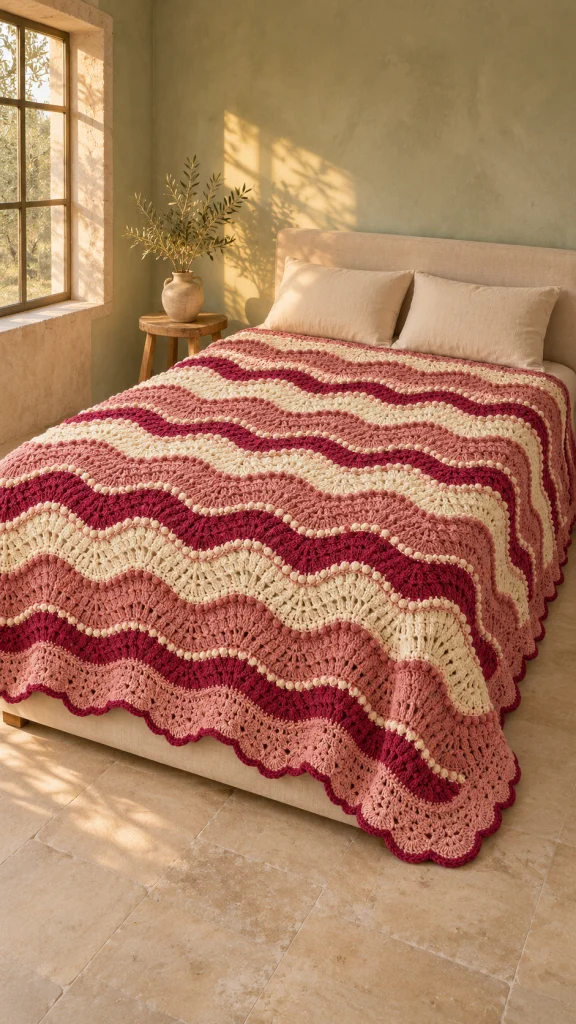
The Rosewood Waves crochet bedspread pattern brings broad lace ripples, raised bobble accents and a soft scalloped outline to a generous bed covering. Dusty rose, burgundy and warm ivory give the waves their distinctive rhythm, while alternating solid and open rows keep the fabric richly textured.
This advanced design is worked across the full width in one piece, with surface bobbles added after the main fabric is complete. Carefully balanced increases and decreases maintain the wave pattern through every stripe. Allow approximately 100–140 hours, plus blocking and drying, and plan on working with the bedspread supported on a table as it grows.
The finished size is approximately 92 × 110 inches, including the border. It suits an experienced crocheter comfortable reading stitch structure, maintaining counts across long rows and adjusting edging tension. These are original, photograph-inspired instructions; the stitch structure is an interpretation of the pictured bedspread.
Materials
- DK yarn in dusty rose: approximately 2,800 m.
- DK yarn in burgundy: approximately 2,800 m, including the final edging.
- DK yarn in warm ivory: approximately 3,200 m, including surface bobbles.
- Choose yarns with the same fiber composition and similar yardage per 100 g; quantities are planning estimates and include a working allowance.
- 4 mm crochet hook, or size required for gauge.
- 4.5 mm crochet hook for the surface bobbles, adjusted if necessary to prevent puckering.
- At least 16 removable stitch markers.
- Tapestry needle and scissors.
- Measuring tape, blocking mats and rustproof pins.
Abbreviations
chchainscsingle crochetdcdouble crochetdc2togdouble crochet two stitches togethersl stslip stitchRSright sideWSwrong sideUS crochet terminology is used. A stitch position means either a stitch or a ch-1 space. Starting ch-2 does not count as a stitch.
Special Stitches and Repeat Structure
- For dc2tog: yarn over, insert into the next stitch, draw up a loop, yarn over and draw through two loops; repeat this partial double crochet in the following stitch, then yarn over and draw through all three loops. Two stitches become one.
- Solid wave repeat: 2 dc in the next stitch, dc in each of the next 9 stitches, dc2tog twice, dc in each of the next 9 stitches, 2 dc in the next stitch. Each repeat consumes 24 stitches and produces 24 stitches.
- Lace wave repeat: 2 dc in the next stitch; work (ch 1, skip the next stitch, dc in the next stitch) four times; dc in the next stitch; dc2tog twice; work (dc in the next stitch, ch 1, skip the next stitch) four times; dc in the next stitch; 2 dc in the next stitch. Each repeat consumes 24 stitches and produces 16 dc and 8 ch-1 spaces: 24 positions.
- When a solid row follows a lace row, work one dc into each ch-1 space wherever the repeat calls for an ordinary dc. The two dc2tog decreases fall over the central four dc of each repeat, never over chain spaces.
- For a surface bobble: insert the hook through the fabric at the specified anchor and draw an ivory loop from the WS to the RS. Ch 1; holding the yarn behind the fabric, work five partial dc through that same anchor, leaving the final loop of each on the hook. Yarn over and draw through all six loops; ch 1 to close. Keep the bobble on the RS.
Gauge Swatch
- With dusty rose, ch 49. Sc in the second chain from the hook and each remaining chain. Turn. Count: 48 sc.
- Swatch Row 1: ch 2; work the solid wave repeat twice. Turn. Count: 48 dc.
- Swatch Row 2: ch 2; work the lace wave repeat twice. Turn. Count: 32 dc and 16 ch-1 spaces.
- Swatch Row 3: ch 2; work the solid wave repeat twice, treating each chain space as one position. Turn. Count: 48 dc.
- Swatch Row 4: repeat Swatch Row 1. Count: 48 dc.
- Swatch Row 5: repeat Swatch Row 2. Count: 32 dc and 16 ch-1 spaces.
- Swatch Row 6: repeat Swatch Row 3. Change to burgundy on the final pull-through. Count: 48 dc.
- Swatch Rows 7–12: repeat Swatch Rows 1–6 in burgundy, keeping burgundy at the end. Fasten off. Each row retains 48 positions.
- Add surface bobbles along Swatch Row 6 using the placement method below. Wet-block and let dry. Two repeats should span approximately 12.8 inches; 12 pattern rows should measure approximately 8 inches in depth, excluding the foundation.
Main Bedspread Foundation and First Stripe
- With dusty rose and the main hook, ch 337. Sc in the second chain from the hook and each remaining chain. Turn. Count: 336 sc. This foundation is Row 0 and is excluded from the 162 pattern rows.
- Place markers after every 24 foundation stitches to identify 14 repeats. Move the markers upward as you work; each marks the end of a repeat.
- Row 1, RS: ch 2; work the solid wave repeat 14 times. Turn. Count: 336 dc.
- Row 2, WS: ch 2; work the lace wave repeat 14 times. Turn. Count: 224 dc and 112 ch-1 spaces, or 336 positions.
- Row 3, RS: ch 2; work the solid wave repeat 14 times, working ordinary dc into chain spaces where encountered. Turn. Count: 336 dc.
- Row 4, WS: ch 2; work the solid wave repeat 14 times. Turn. Count: 336 dc.
- Row 5, RS: ch 2; work the lace wave repeat 14 times. Turn. Count: 224 dc and 112 ch-1 spaces.
- Row 6, WS: ch 2; work the solid wave repeat 14 times. On the final pull-through of the last dc, change to burgundy. Turn. Count: 336 dc. Cut dusty rose, leaving a weaving tail.
Stripe Layout and Remaining Rows
- Use this six-row stripe sequence throughout: solid wave, lace wave, solid wave, solid wave, lace wave, solid wave. Every row has 336 positions; solid rows have 336 dc, and lace rows have 224 dc plus 112 ch-1 spaces.
- Rows 7–12: work one six-row stripe in burgundy. Change to ivory on the final pull-through of Row 12.
- Rows 13–18: work one six-row stripe in ivory. Change to dusty rose on the final pull-through of Row 18.
- Rows 19–162: repeat the complete 18-row sequence seven more times, then work it once again for the final set. Equivalently, work eight additional sets of dusty rose for six rows, burgundy for six rows and ivory for six rows. This adds 144 rows to the first 18.
- Change colors only at the end of each six-row stripe. There are nine complete 18-row sets: 27 stripes in total, with nine stripes in each color. Row 162 is ivory and has 336 dc. Fasten off.
- Check the unbordered fabric against its target of approximately 89.6 inches wide and 108 inches long, allowing for the shallow foundation and the natural wave profile. Measure across the central fabric, away from unsupported hanging edges.
Raised Ivory Bobble Lines
- Lay the bedspread RS up. Add a bobble line along the top of every completed dusty rose and burgundy stripe: Rows 6, 12, 24, 30, 42, 48, 60, 66, 78, 84, 96, 102, 114, 120, 132, 138, 150 and 156. There are 18 lines.
- Number the 336 stitches of each selected row from left to right as viewed from the RS, regardless of the direction in which that row was crocheted. Anchor the bobbles through the stitch heads of that row.
- With ivory and the larger hook, make a surface bobble at stitch 2. Ch 3 loosely; skip three stitch heads and make the next bobble at stitch 6. Repeat this spacing across the row, making bobbles at stitches 2, 6, 10 and every fourth stitch through stitch 334. Count: 84 bobbles per line.
- Keep each connecting ch-3 on the fabric surface, following the wave rather than bridging across its valleys. After the bobble at stitch 334, fasten off and secure the tail on the WS. Total across all 18 lines: 1,512 bobbles.
- Spread each completed line flat before proceeding. If it draws the fabric inward, remake that line with a larger hook or longer connecting chains; retain the same anchor positions and bobble count.
Continuous Border
- With the RS facing, join dusty rose at the first stitch of Row 162. Ch 1 and sc in all 336 stitches across the top, preserving the wave contour. Ch 2 for the corner.
- Work down the first side, placing 2 sc around the end of each of the 162 pattern rows. Count: 324 side sc. Do not add a separate pickup into the foundation-row end. Ch 2 for the corner.
- Sc into each of the 336 unused foundation-chain loops along the lower edge. Ch 2 for the corner. Count: 336 lower-edge sc.
- Work up the remaining side, placing 2 sc around each of the 162 pattern-row ends. Count: 324 side sc. Ch 2 and join with a sl st to the first sc. Border Round 1 count: 1,320 sc and four ch-2 corner spaces.
- Border Round 2: ch 1; sc in every sc around, working (sc, ch 2, sc) into each corner space. Join with a sl st to the first sc. Count: 1,328 sc and four ch-2 spaces. Fasten off dusty rose.
- Border Round 3: join burgundy in any sc; ch 1, sc in every sc around and work (sc, ch 2, sc) in each corner space. Join with a sl st to the first sc. Count: 1,336 sc and four ch-2 spaces. Fasten off.
- The border follows the existing waves at the short ends and gives the long sides a narrow, stable outline. Lay the work flat after every round; adjust hook size if the side edging flares or contracts.
Finishing
- Weave each stripe tail through several stitch backs of its own color, reverse direction and weave through a second path. Secure bobble-line tails independently so a loose end cannot release a whole line.
- Wash or dampen according to the yarn label. Support the full wet bedspread when moving it, then spread it over a clean, flat surface.
- Arrange the waves into even curves and gently ease the border flat. Aim for approximately 92 × 110 inches without forcing the lace open or flattening the bobbles. Let the fabric dry completely before lifting it.
The main fabric is a single panel, so no seams or motif assembly are needed. Once dry, smooth it over the bed with the bobbles facing upward and let the scalloped ends settle naturally.
Tips for Success
- Count every 24-position repeat separately on lace rows; chain spaces count as positions.
- Keep the central two dc2tog groups aligned with the valley of the preceding row.
- Add bobble lines with the fabric resting flat so their connecting chains do not shorten the waves.
- Support completed fabric on a table or beside you; its weight can stretch the active row.
- Keep a row tally that records both the stripe color and the position within the six-row sequence.
Common Mistakes to Avoid
- Counting the turning ch-2 as a stitch adds width. Work into the first actual stitch and leave the turning chain unworked.
- Working into both the chain and the space beneath it increases the count. Each ch-1 space receives one ordinary dc on the following solid row.
- Missing one of the two consecutive decreases makes the valley drift. Check for two dc2tog groups in every repeat.
- Pulling bobble connectors tightly flattens the scallops. Lengthen the connecting chains before adding further lines.
- Stretching the side border to fit can cause permanent cupping. Check it flat after each round and change hook size when needed.
Ways to Customize This Pattern
- Change width in complete 24-position repeats. For N repeats, chain 24N + 1 and work 24N foundation sc; the approximate unbordered width is 6.4N inches at the stated gauge.
- Change length in complete 18-row color sets. Each set adds approximately 12 inches at the stated row gauge.
- For a narrower throw, use eight repeats and six color sets: chain 193, work 192 foundation sc and 108 pattern rows. The unbordered fabric is approximately 51.2 × 72 inches.
- Use tonal shades of a single color while keeping the lightest yarn for the raised bobble lines.
- Reduce the surface texture by adding bobbles only above burgundy stripes; the main stitch counts and border remain unchanged.
For resized versions, each marked bobble line contains six bobbles per width repeat. Border Round 1 contains twice the foundation stitch count plus four times the number of pattern rows, with four ch-2 corner spaces; each subsequent border round adds eight sc.
Frequently asked questions
Each 24-position repeat contains 16 dc and eight ch-1 spaces. Those spaces replace eight stitches, so the row remains the same width. The following solid row restores 24 dc per repeat.
These instructions use surface bobbles to preserve the balanced ripple repeats. Substituting bobbles into the main rows would require a separately swatched stitch sequence, particularly beside the increases and decreases.
Measure the mattress width and add your preferred drop on both sides. Compare that total with the approximate 92-inch finished width. Check the length separately, allowing for the foot drop and any space you want to leave uncovered near the pillows.
Weigh the blocked swatch before and after adding its bobbles. The main bedspread has seven times the swatch width and 13.5 times its pattern-row count, so its main fabric uses approximately 94.5 times the swatch’s main-fabric yarn. Estimate bobble yarn separately from the number of lines, then allow additional yarn for the border and a reserve.
The finished Rosewood Waves Crochet Bedspread Pattern