Vintage Lace Crochet Bedspread Pattern – Elegant Handmade Blanket Tutorial
There is something truly special about a handmade crochet bedspread. The delicate stitches, beautiful textures, and timeless designs can transform an ordinary bedroom into a warm and inviting retreat.
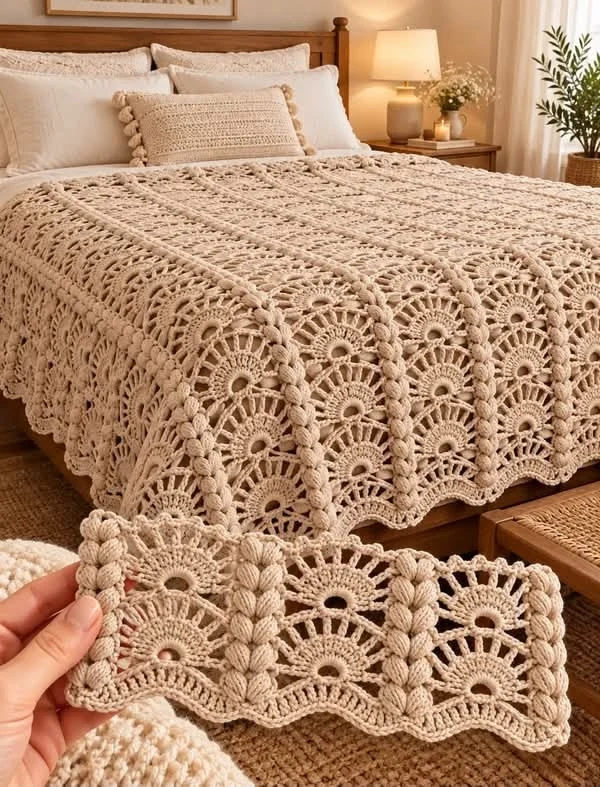
This stunning vintage-inspired crochet bedspread features elegant fan-shaped lace motifs, raised braided columns, and softly scalloped edges. Made in a beautiful warm ivory shade, it combines traditional crochet craftsmanship with a romantic farmhouse style.
The repeating lace design gives the blanket a light, airy appearance, while the textured columns add depth and structure.
Whether you’re decorating a cozy cottage bedroom, creating a special handmade gift, or simply looking for a relaxing crochet project, this beautiful bedspread is a wonderful source of inspiration.
In this tutorial, you’ll learn the techniques needed to create a similar vintage-style crochet blanket, including fan stitches, raised textured columns, and decorative scalloped borders.
Important: This is an original, simplified pattern inspired by the photographed bedspread, not an exact reconstruction. The photograph does not provide enough stitch-level information to verify the original pattern. Make a sample swatch before committing to a full-size blanket.
Project Overview
- Project Name: Vintage Lace Crochet Bedspread
- Skill Level: Intermediate to Advanced
- Style: Vintage, Romantic, Cottagecore, Farmhouse
- Technique: Lace Crochet, Fan Stitches, Raised Texture
- Yarn Weight: DK or Light Worsted
- Suggested Hook: 3.5–4.5 mm
- Color: Warm Ivory or Natural Cream
- Terminology: US Crochet Terms
- Construction: Repeating Lace Panels with Decorative Borders
Materials You’ll Need
- DK or light worsted cotton-blend yarn
- 3.5 mm or 4 mm crochet hook
- Stitch markers
- Yarn needle
- Sharp scissors
- Measuring tape
- Blocking mats
- Rustproof blocking pins
Suggested Yarn Colors
The warm ivory shade shown in the photograph is especially beautiful because it highlights the intricate lace details.
Other lovely options include:
- Antique white
- Soft champagne
- Natural cotton
- Warm oatmeal
- Dusty blush
- Sage green
- Light beige
Understanding the Crochet Design
The inspiration photograph shows three important design elements:
1. Repeating Fan Lace Motifs
The most recognizable feature is the repeating fan-shaped lace pattern.
Each fan contains an open center, radiating crochet stitches, and a curved outer edge.
These motifs create a beautiful architectural appearance similar to vintage crocheted lace.
2. Raised Braided Columns
Between the lace sections are prominent raised columns resembling thick braided cords.
These columns create a dimensional contrast against the delicate openwork.
For an accessible interpretation, separate crochet cords can be made and sewn between the lace panels.
3. Scalloped Edges
The bottom edge features softly curved scallops that follow the fan motifs.
This decorative border gives the bedspread its elegant, romantic finish.
Crochet Abbreviations
- ch: Chain
- sc: Single Crochet
- hdc: Half Double Crochet
- dc: Double Crochet
- tr: Treble Crochet
- sl st: Slip Stitch
- st: Stitch
- sp: Space
- rep: Repeat
- FO: Fasten Off
Part 1 – Crochet a Vintage Fan Lace Motif
Begin by practicing the decorative fan motif before making the full bedspread.
This simplified fan is worked in turned rows and can be used as a sample for planning larger lace panels.
Foundation
Ch 6.
Join with a sl st to form a ring.
Row 1 – Create the Fan Base
Ch 3 (counts as first dc).
Work 6 dc into the ring.
Turn.
You should have 7 dc.
Row 2 – Begin the Openwork
Ch 4 (counts as dc and ch 1).
Work (dc in next dc, ch 1) six times.
Turn.
You should have 7 dc separated by 6 chain spaces.
Row 3 – Expand the Fan
Ch 3 (counts as first dc).
Work 1 dc in the first dc.
For each of the next five dc, work 2 dc in the stitch.
Work 3 dc in the last dc.
Turn.
You should have 15 dc.
Row 4 – Decorative Lace Openings
Ch 4 (counts as dc and ch 1).
Skip the next stitch.
Work (dc in next stitch, ch 1, skip next stitch) six times.
Work 1 dc in the last stitch.
Turn.
You should have 8 dc and 7 chain spaces.
Row 5 – Rounded Fan Edge
Ch 1.
Work 1 sc in the first dc.
Work 3 dc in each of the seven chain spaces, with 1 sc in each intervening dc.
Work 1 sc in the final dc.
FO and weave in the ends.
Your finished sample should have a rounded fan silhouette with decorative openwork.
This is a standalone fan sample, not a verified continuous repeat for the photographed bedspread.
Part 2 – Create the Raised Braided Columns
The thick raised columns are an important feature of the vintage design.
A practical way to recreate this texture is to crochet separate cords and attach them between the lace panels.
Make a Simple Crochet Cord
Ch 3.
Insert the hook into the second chain from the hook and pull up a loop.
Insert the hook into the next chain and pull up another loop.
You should have three loops on your hook.
Carefully remove the first two loops, holding them securely.
Yarn over and pull through the remaining loop.
Replace the second loop and work through it.
Replace the final loop and work through it.
Repeat this process to create an I-cord of your desired length.
For a fuller braided appearance, make three matching cords and braid them together.
Secure the ends before attaching the braid to your lace panel.
Part 3 – Plan Your Bedspread Size
Before making the complete blanket, decide on your preferred finished dimensions.
Suggested Bedspread Sizes
- Throw: 127 × 152 cm (50 × 60 inches)
- Twin: 168 × 229 cm (66 × 90 inches)
- Full: 203 × 229 cm (80 × 90 inches)
- Queen: 229 × 254 cm (90 × 100 inches)
- King: 274 × 254 cm (108 × 100 inches)
These are suggested finished measurements, not guaranteed results from a fixed stitch count.
Make a Gauge Swatch
Crochet several fan motifs using your chosen yarn and hook.
Block the samples and measure their finished dimensions.
Use the measurements to calculate how many motifs or panels you will need.
Remember to include the width of the raised braided columns and any joining spaces.
Part 4 – Build the Lace Panels
The photographed bedspread has long repeating sections of fan-shaped lace.
To make a similar blanket, arrange the fan motifs in vertical strips.
Each strip should contain the same number of motifs.
For a simplified modular construction:
- Crochet enough individual fan motifs for one vertical strip.
- Block the motifs to consistent measurements.
- Arrange them in an overlapping fan layout.
- Join adjacent motifs with sewing or crochet joining stitches.
- Repeat to create additional strips.
- Connect the strips with narrow lace bands or decorative crochet joins.
For the most consistent result, test the joining method on two motifs before making the full blanket.
The exact joining geometry depends on the width and curvature of your chosen motifs.
Part 5 – Add the Raised Columns
Once the lace strips are assembled, prepare the raised braided cords.
Make each cord long enough to run along the length of a lace panel.
Lay the cords between the lace strips.
Pin them into position before sewing.
Use matching yarn and a tapestry needle to attach the cords securely.
Keep the tension even to prevent the bedspread from puckering.
The raised columns should sit slightly above the lace surface.
Part 6 – Crochet a Scalloped Border
A beautiful scalloped border completes the vintage look.
Use the same yarn as the main bedspread.
Simple Scalloped Border
Round 1: Work sc evenly around the blanket edge, adjusting the number of stitches so the fabric lies flat.
At each corner, work 3 sc into the corner space.
Join with a sl st.
Round 2: Ch 1, sc in the first stitch.
Repeat the following sequence along each straight edge:
Skip 2 stitches, work 5 dc in the next stitch, skip 2 stitches, sc in the next stitch.
Adjust the spacing near corners to keep the border smooth.
Join with a sl st and FO.
Weave in the ends carefully.
This produces a simple shell-style scallop. The deeper, architectural scallops shown in the reference would require a more complex shaped lace edging.
Part 7 – Block Your Finished Crochet Bedspread
Blocking is especially important for openwork lace.
It helps the fan motifs open evenly and gives the blanket a more polished appearance.
- Check the yarn label for washing instructions.
- Gently wet or steam the blanket using a method suitable for your yarn.
- Lay the bedspread flat on blocking mats.
- Carefully shape the fan motifs.
- Pin the scalloped edges into smooth curves.
- Allow the blanket to dry completely before removing the pins.
Avoid stretching the raised columns excessively.
How to Style Your Vintage Crochet Bedspread
Cozy Farmhouse Bedroom
Pair the ivory crochet bedspread with natural wooden furniture, linen pillows, and soft neutral bedding.
Romantic Cottage Bedroom
Add floral cushions, antique-inspired lamps, and delicate curtains for a soft vintage atmosphere.
Minimalist Neutral Bedroom
Let the intricate crochet texture become the focal point by keeping the rest of the room simple.
Classic Traditional Bedroom
Combine the bedspread with embroidered pillowcases and warm wooden furniture.
Tips for a Beautiful Lace Crochet Blanket
- Choose a yarn with good stitch definition.
- Use consistent tension throughout the project.
- Make a sample before starting the full bedspread.
- Block each panel before joining.
- Count stitches carefully when creating lace motifs.
- Use stitch markers to track pattern repeats.
- Keep braided columns the same length.
- Check measurements regularly.
- Weave in yarn ends securely.
- Allow enough time for careful finishing.
Frequently Asked Questions
Is this crochet bedspread suitable for beginners?
The complete project is better suited to intermediate or advanced crocheters. Beginners can practice the individual fan motifs first.
What yarn works best for a vintage crochet bedspread?
Cotton and cotton-blend yarns are popular choices because they offer beautiful stitch definition and a classic lace appearance.
Can I make this blanket in another color?
Absolutely! Antique white, dusty rose, sage green, champagne, and light beige are all lovely options.
How much yarn will I need?
The amount depends on the blanket size, yarn thickness, stitch density, and final motif design. A reliable estimate requires weighing a finished gauge sample and scaling it to the intended dimensions.
Can I make a smaller version?
Yes. A smaller throw or decorative blanket is a good way to practice the lace techniques before making a full bedspread.
How do I keep the lace pattern even?
Maintain consistent tension, count stitches regularly, and block each completed section.
Can I machine wash the finished bedspread?
Follow the care instructions for your chosen yarn. Delicate lace may benefit from gentle hand washing and flat drying.
Can I make matching pillow covers?
Yes! Use coordinating fan motifs and decorative borders to create matching pillow covers.
Final Thoughts
A vintage lace crochet bedspread is more than just a blanket. It’s a beautiful handmade piece that celebrates patience, creativity, and traditional craftsmanship.
With its delicate fan motifs, raised braided details, and softly scalloped edges, this design brings elegance and warmth to almost any bedroom.
Whether you choose classic ivory or a soft modern color, your finished crochet bedspread can become a treasured part of your home.
Take your time, enjoy the beautiful stitch textures, and create something truly special with your own hands.
Happy crocheting! 🧶🤍